


Project Location: Nanhe District, Xingtai City, Hebei Province
Total Building Area: 35,000 square meters




Project Location: Nanhe District, Xingtai City, Hebei Province
Total Building Area: 35,000 square meters
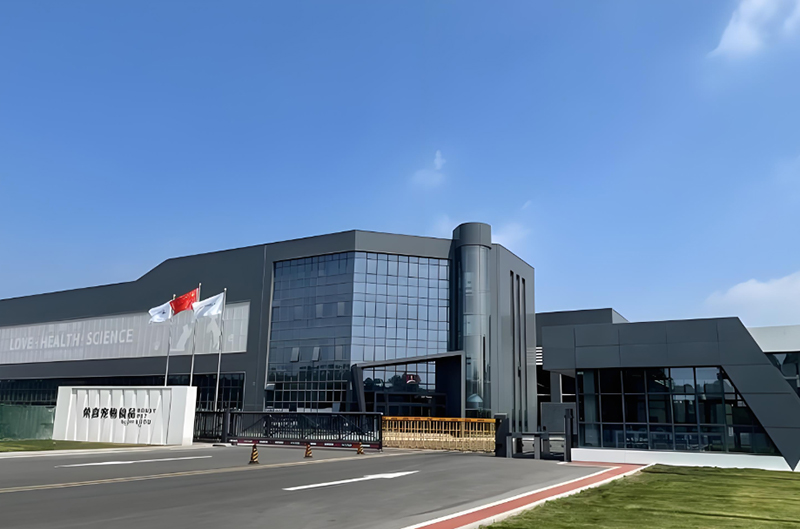

Project Introduction
The buildings within the Hebei Rongxi Pet Food Co., Ltd. industrial park primarily utilize light steel structures. In particular, the "Heart Factory" Phase II project—completed and commissioned in 2022—stands as a quintessential example of modern industrial architecture featuring steel construction.
I. Structural Innovation: Large-Span, Column-Free Space—Eliminating "Dead Zones"
Core Logic: Leveraging the high structural strength inherent in steel construction to achieve an ultra-large-span (typically exceeding 30 meters), column-free design.
Innovative Value: The campus architecture features a sleek, modern aesthetic—predominantly utilizing a blue-and-white color scheme—that embodies the high-tech ethos of an "Industry 4.0" smart factory. The factory interior boasts a vast, open layout that facilitates the efficient arrangement of large-scale automated production lines.
Phase II "Heart Factory": Covering a site area of 58 *mu* (approx. 3.87 hectares) with a total floor area of approximately 37,500 square meters, this facility boasts an annual production capacity of 80,000 tons. This building serves as the central vehicle for Rongxi’s intelligent modernization upgrade, housing fully automated production lines and a smart warehousing system.
Production Workshop: Constructed using a light-gauge steel frame structure, the design prioritizes optimal ventilation, natural lighting, corrosion resistance, and explosion protection—thereby meeting the rigorous standards required for a food-grade production environment.
II. Material Innovation: Composite Insulation and Anti-Corrosion Systems—Ensuring "Warm in Winter, Cool in Summer"
Core Logic: Implementation of a building envelope system comprising a "steel structural skeleton + composite insulated sandwich panels."
Innovative Value: Thermal Insulation: The walls are constructed using 10-centimeter-thick polyurethane or rock wool sandwich panels, characterized by extremely low thermal conductivity. This ensures a constant internal temperature within the workshop—not only reducing energy consumption (saving approximately one-third compared to standard factory buildings) but, more critically, guaranteeing the precise temperature and humidity-controlled environment essential for pet food production, thereby preventing product spoilage caused by temperature fluctuations.
Corrosion and Bacterial Resistance: The steel surfaces feature a composite anti-corrosion system utilizing hot-dip galvanizing topped with a fluorocarbon paint finish; the wall panels possess a mirror-smooth, antibacterial surface. This design not only extends the building's service life (potentially exceeding 50 years) but also facilitates easy cleaning and disinfection via high-pressure water jets—thereby satisfying the stringent food-grade production requirements for surfaces that are "easy to clean and resistant to bacterial growth."
III. Functional Innovation: "Integrated" Design of Architecture and Production Lines
Core Logic: The architectural design is deeply integrated with the production process workflow, incorporating pre-allocated interfaces for intelligent systems.
Innovative Value: Reserved Space for Future Modification: The steel structure utilizes standardized components and features pre-allocated "modification interfaces." When production lines require upgrading or adjustment, there is no need to dismantle the primary structural framework; one simply needs to install new steel beams at pre-designated connection nodes. This approach enables the facility to undergo "flexible expansion," thereby effectively accommodating the demands of the enterprise's rapid growth.
Reserved Space for Modification: The steel structure utilizes standardized components and incorporates "modification interfaces." Consequently, when production lines require upgrading or adjustment, there is no need to dismantle the primary structural framework; one simply needs to install new steel beams at pre-designated connection nodes. This approach enables the facility to undergo "flexible expansion," thereby effectively accommodating the demands of the enterprise's rapid growth.
Rongxi’s innovation in steel-structure architecture fundamentally elevates the concept of "industrial buildings" to that of "food-grade production environments." Through structural optimization, it resolves complex hygiene challenges; through material upgrades, it ensures environmental stability; and through the reservation of functional space, it adapts to future developmental needs. It stands as a quintessential example of the transformation of traditional pet food manufacturing facilities into modern, intelligent industrial complexes.
INTERESTED IN SIMILAR PROJECTS?
We are able to flexibly respond to various challenges ranging from standard factories to complex landmark buildings, providing you with truly tailored solutions.
Get A Free Quote
Related Products


