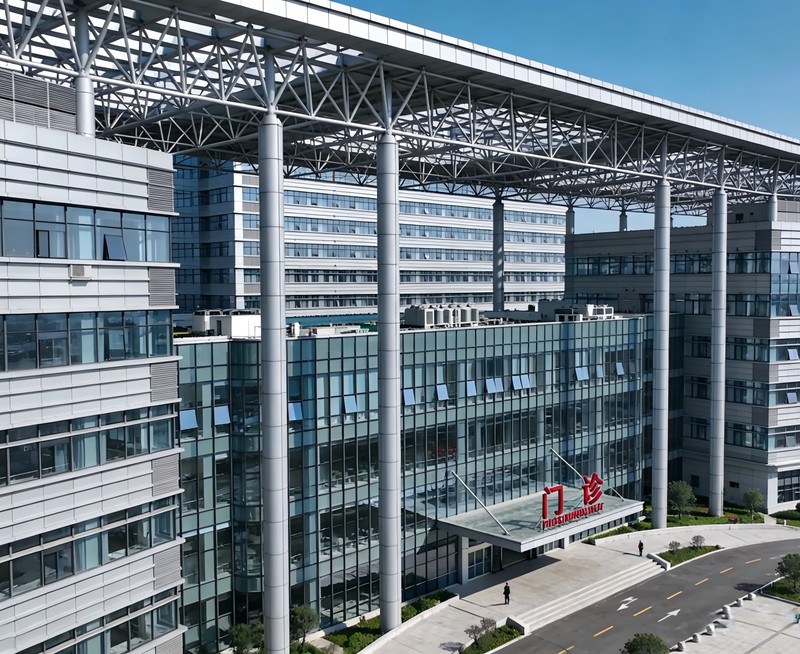
As a professional exporter of custom steel structure buildings, we are committed to providing high-standard, customizable steel structure hospital solutions that meet international medical building norms and global quality standards. Our products are widely applied in global medical construction projects, including general hospitals, specialized hospitals, community health centers, emergency medical facilities, isolation wards, and "flat-emergency dual-purpose" medical buildings, with reliable quality, flexible customization, and comprehensive after-sales support. The following detailed introduction covers definitions, characteristics, advantages, specifications, customization content, and scope to help you fully understand our offerings and meet your global medical construction needs.
A steel structure hospital is a professional medical facility that takes high-strength steel as the main load-bearing structure, integrates medical treatment, diagnosis, nursing, health care, emergency rescue and other functions, and adopts modular prefabrication and intelligent construction technologies . Its core components, including steel frames, steel columns, steel beams, core tubes, and medical functional modules, are prefabricated in the factory with standardized production, then transported to the construction site for hoisting and assembly . It is divided into permanent medical buildings and temporary emergency medical facilities, which can flexibly meet the functional needs of different types of medical institutions, including general wards, operating rooms, intensive care units (ICUs), imaging centers, laboratories, and isolation areas . Our steel structure hospitals fully comply with international standards such as AISC 360-22, EN 1993, ISO 9001, and local medical building codes [6], and integrate the concepts of green environmental protection, energy conservation, intelligence, and humanization, which is an important development direction of modern medical building industrialization.
Product Characteristics
Flexible Space Layout & Medical Function Adaptability
The steel structure has excellent spatial adaptability, with a standard column grid of 6-12m , which can flexibly divide functional areas according to medical needs, such as clean operating rooms, ICUs, sterile wards, imaging centers, and laboratories. It can realize large-area column-free space, facilitate the layout of medical equipment (such as CT, MRI), and meet the strict requirements of medical clean areas (class 100-10000 clean grade). The modular design allows free combination of functional units, which is convenient for later expansion and adjustment of ward quantity and functional layout, adapting to the upgrading of medical services.
Light Weight & High Structural Safety
The main structure adopts high-quality high-strength steel (Q235B, Q355B, Q460, ASTM A36) , with excellent tensile and compressive strength. The weight of the steel structure is only 1/3-1/5 of that of the traditional reinforced concrete structure, which can effectively reduce the foundation load, save foundation construction costs, and adapt to complex urban or remote area geological conditions . It has strong seismic resistance (grade 8-9) and wind resistance (grade 10-12), and the lateral displacement limit ≤H/500 (H is the building height), ensuring the safety of medical equipment and personnel during long-term use.
High Prefabrication Degree & Efficient Construction
90% of the components are prefabricated in the factory with precision machining, ensuring the accuracy and quality consistency of the components . On-site construction only requires hoisting and assembly, reducing on-site wet work by 80%, and the construction efficiency is 50-70% higher than that of traditional concrete hospitals . For emergency medical facilities, it can be completed and put into use within weeks, which is especially suitable for emergency deployment in pandemic or disaster areas [5]. BIM digital pre-assembly technology is adopted to avoid construction errors and further improve construction efficiency.
Green Energy-Saving & Sustainable
Steel materials can be 100% recycled and reused, which conforms to the global low-carbon and environmental protection development trend . Prefabricated construction reduces construction waste by 70%, realizing green construction . The steel structure is matched with high-performance thermal insulation and sound insulation materials, and the thermal insulation K-value ≤1.8W/(㎡·K), which can effectively maintain the constant temperature and humidity environment required by medical areas, reduce energy consumption of air conditioning and heating, and meet the requirements of green medical buildings.
Intelligent & Humanized Design
It can be integrated with intelligent medical systems, such as intelligent ward monitoring, medical equipment management, air purification, and emergency evacuation systems, improving the efficiency of medical management and the comfort of patients . The interior design conforms to the barrier-free design specifications, with reasonable layout of medical passages and patient passages, convenient for the transfer of patients and medical equipment. The exterior design adopts a simple and generous style, with good lighting and ventilation effects, creating a comfortable medical environment for patients and medical staff .
Product Advantages
Compliance with International Medical Standards
All products are produced in accordance with international standards such as AISC 360-22, EN 1993, ISO 9001, and local medical building codes , and meet the strict requirements of medical clean areas, fire protection, and radiation protection. They have passed CE, ASTM, and other international certifications, ensuring smooth customs clearance and avoiding quality inspection risks. The design fully complies with the functional requirements of modern medical buildings, such as sterile isolation, medical equipment layout, and emergency rescue .
Compliance with International Medical Standards
All products are produced in accordance with international standards such as AISC 360-22, EN 1993, ISO 9001, and local medical building codes , and meet the strict requirements of medical clean areas, fire protection, and radiation protection. They have passed CE, ASTM, and other international certifications, ensuring smooth customs clearance and avoiding quality inspection risks. The design fully complies with the functional requirements of modern medical buildings, such as sterile isolation, medical equipment layout, and emergency rescue.
Superior Safety & Reliability
The fire rating reaches Grade A1 (non-combustible), with a fire resistance limit ≥3.0 hours, equipped with an intelligent fire detection system, fire-fighting sprinkler system, and fire compartment division, which can effectively prevent fire spread and ensure the safety of medical equipment and personnel [4]. The steel components are treated with hot-dip galvanizing and anti-corrosion coating, which has strong anti-corrosion and anti-rust performance, adapting to harsh climates such as coastal areas and high humidity areas, and the service life of the main structure can reach 50-100 years .
Cost-Effective & Low Comprehensive Cost
Although the initial investment of steel structure is slightly higher, the prefabricated production reduces on-site labor costs and construction period costs by 30-50% . The later maintenance cost is 70% lower than that of concrete hospitals, and the steel can be recycled, reducing the life-cycle cost . For emergency medical facilities, rapid construction and deployment can save emergency investment and realize early put into use, creating greater social and economic benefits .
Strong Customization & Global Adaptability
We can customize the number of floors, area, structural system, functional layout, clean grade, and supporting facilities according to the customer's medical positioning, regional climate, geological conditions, and local standards . It can be adapted to different regions such as coastal areas (anti-corrosion design), plateau areas (anti-freezing design), and earthquake-prone areas (seismic reinforcement design), and can be customized for different types of hospitals (general hospitals, specialized hospitals, emergency facilities) .
Professional One-Stop Service
We provide one-stop services from design, production, transportation to installation, covering the whole process of medical building construction . We have a professional technical team with rich experience in medical building design and construction, which can provide on-site installation guidance and technical training . We provide 24/7 global after-sales support and regular maintenance services to solve the worries of customers in the later stage.
Our Customization Content & Scope
We focus on providing one-stop customization services for steel structure hospitals, covering the entire process from design, production, transportation to installation, and comprehensively meeting the personalized needs of global medical institutions. Combining with international medical building standards, local medical norms and building codes, we provide professional customization solutions to ensure that the products are compliant, practical, safe and energy-saving, and meet the functional needs of different types of medical services.
01
Structural Design Customization
According to the customer's medical positioning (general hospital, specialized hospital, emergency facility), scale and functional needs, customize the number of floors, height, area, span, structural system (steel frame, steel frame-core tube, modular structure, etc.) . Combine the local climate, geological conditions and seismic standards to optimize the structural design, carry out mechanical simulation and environmental simulation, ensure the structural stability and safety, and meet the requirements of medical clean areas and equipment layout. Provide professional 3D design drawings, renderings and structural calculation reports for customer confirmation .
02
Medical Function Customization
Customize the functional layout according to medical needs, including operating rooms, ICUs, general wards, isolation wards, imaging centers, laboratories, pharmacies, and medical offices. Customize the clean grade of each functional area (100-100000 grade), and design the air purification system, medical gas supply system and sterile isolation system to meet the strict requirements of medical treatment. Customize the layout of medical equipment to facilitate the operation and maintenance of equipment.
03
Material Customization
According to the customer's budget, use environment and local standards, select appropriate steel materials, thermal insulation materials, sound insulation materials, and clean decoration materials . All materials meet international environmental protection and medical standards, and can be customized according to the anti-corrosion, anti-freezing and other requirements of different regions (such as coastal anti-corrosion treatment, plateau anti-freezing design). The materials of clean areas are non-toxic, odorless and easy to clean, meeting the requirements of medical sterile environment.
04
Supporting Facilities Customization
Customize supporting facilities according to medical needs, including intelligent medical monitoring system, air purification system, emergency evacuation system, medical gas supply system, stretcher elevator, barrier-free facilities, medical waste treatment system, and fire protection system . It can also be integrated with intelligent operation and maintenance systems to realize intelligent management of the hospital, such as intelligent environment control and medical equipment monitoring, improving medical management efficiency.
05
Hospital Type Customization
Customize according to the type of hospital, including general hospitals, specialized hospitals (pediatrics, obstetrics and gynecology, orthopedics, etc.), community health centers, emergency medical facilities, isolation wards, and "flat-emergency dual-purpose" medical buildings . Design corresponding structural forms and functional layouts for different types of hospitals to meet the professional needs of medical treatment.
06
Regional Adaptation Customization
According to the climate and geological conditions of the customer's location, carry out targeted customization, such as anti-corrosion treatment for coastal areas (preventing sea salt erosion), anti-freezing design for plateau areas, and seismic reinforcement design for earthquake-prone areas . Optimize the thermal insulation, ventilation and other designs according to the local climate characteristics to ensure that the hospital can adapt to the local natural environment and meet the local medical building codes.
07
Export & Installation Customization
Provide global export transportation services, including container packaging, customs declaration, shipping, etc., to ensure that the components are safely transported to the customer's designated location (adapt to sea transportation, land transportation and other modes). Provide on-site installation guidance services, send professional engineers to the site to guide hoisting and assembly, adopt BIM digital pre-assembly technology to ensure construction quality and safety , and provide technical training for the customer's staff. Provide long-term after-sales maintenance services and technical support.
08
Standard Compliance Customization
According to the import standards, medical building norms and building codes of the customer's country, customize the product design and production, ensure that the product meets the local CE, ASTM, ISO and other certification requirements, and provide relevant certification documents to ensure smooth customs clearance and avoid quality inspection risks . The clean grade, fire protection indicators and other parameters fully comply with local medical standards.
Core Structural Systems
System Type
Application Scope
Key Features
Steel Frame System
Community health centers, small specialized hospitals, temporary isolation wards (1-6 floors)
Simple structure, low cost, fast construction, flexible space division
Steel Frame-Braced System
General hospitals, specialized hospitals (6-15 floors)
High lateral stiffness, strong seismic resistance, suitable for multi-storey medical buildings
Steel Frame-Core Tube System
Large general hospitals, medical complexes (15-30 floors)
Large usable space, good stability, suitable for high-rise medical buildings with complex functions
Modular Steel Structure System
Emergency medical facilities, isolation wards, temporary hospitals
Rapid assembly, detachable and reusable, suitable for emergency deployment
Specifications & Parameters
Parameter Category
English Specifications
Main Structural Materials
High-strength steel (Q235B, Q355B, Q460, ASTM A36), steel plate thickness 8-30mm; steel pipe diameter 150-800mm; columns can adopt box-shaped steel or concrete-filled steel tube ; connectors are high-strength bolts complying with GB/T 3098.1 standard
Fire rating: Grade A1 (non-combustible); fire resistance limit: ≥3.0 hours; fireproof coating thickness: 20-40mm; equipped with intelligent fire detection, fire-fighting sprinkler system and fire compartment division
Clean Grade
Operating room: Class 100-1000; ICU: Class 1000-10000; general ward: Class 100000 (customizable according to medical needs)
Service Life
Main structure: 50-100 years; curtain wall & auxiliary facilities: 20-30 years; temporary emergency hospital: 10-20 years (reusable)
Construction Cycle
Factory prefabrication: 30-60 days; on-site hoisting and assembly: 30-120 days (depending on floors and area); emergency hospital: 7-20 days to complete deployment
Supporting Facilities
Intelligent medical monitoring system, air purification system, emergency evacuation system, medical gas supply system, sterile operating room equipment, ICU monitoring equipment, elevator (including stretcher elevator), barrier-free facilities, medical waste treatment system (customizable)
INTERESTED IN SIMILAR PROJECTS?
We are able to flexibly respond to various challenges ranging from standard factories to complex landmark buildings, providing you with truly tailored solutions.